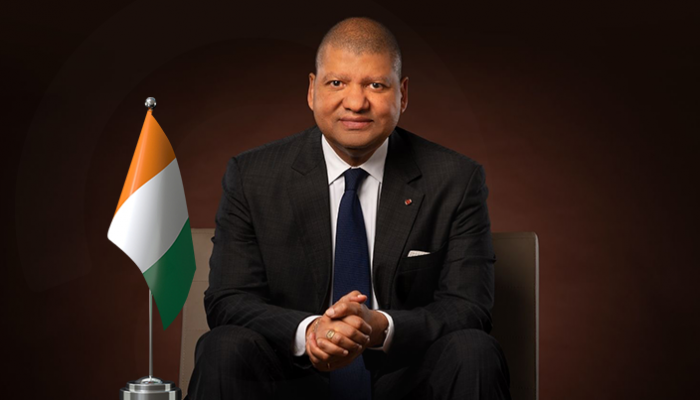
Abidjan, Côte d’Ivoire – October 19, 2025: Jean-Louis Billon, presidential candidate for Côte d’Ivoire’s opposition Democratic Congress (CODE) coalition, held a campaign rally in Abobo, a working-class district of Abidjan, on Saturday, October 18. The 60-year-old former trade minister addressed a crowd in a neighborhood historically considered a stronghold of incumbent President Alassane Ouattara’s ruling Rally of Houphouëtists for Democracy and Peace (RHDP) party.
Speaking to supporters, Billon outlined his campaign platform focused on economic recovery, social justice, and youth employment. “I want to speak to the young, to the women, to those who are forgotten, those without title or rank,” Billon told the crowd. “I want to reassure them that they are not forgotten. And Abobo will not be forgotten”.
Rally participant Eric Okoi told media that supporters see Billon as “the candidate of renewal,” citing three reasons for backing him: his relative youth, his social policies aimed at young people and women, and the “hope for the transformation of Ivorian society” he represents. Another supporter, Fabyra Koffi, stated that women being “a pillar of development” in Billon’s vision motivated her support, adding: “I urge everyone to choose this candidate because he has the right CV for our generation”.
Billon is running under the banner of CODE, a coalition that united eighteen political parties behind his candidacy in August 2025. The coalition’s platform emphasizes national reconciliation, democratic reform, youth empowerment, and sustainable economic development. Billon, born December 8, 1964, served as Minister of Commerce from 2012 to 2015 and is a prominent businessman leading the Sifca industrial group.
Campaign Unfolds Amid Protest Ban and Political Restrictions
The Abobo rally took place against a backdrop of heightened restrictions on political activity. On October 17, Interior and Security Minister Vagondo Diomande and Defense Minister Téné Birahima Ouattara issued a decree imposing a two-month ban on all public demonstrations and gatherings organized by political parties or groups. The measure, which took immediate effect, permits only events directly related to the October 25 presidential election process, with violations subject to prosecution.
Authorities stated the ban aims to “maintain public order and safeguard national security during the electoral period.” Implementation has been entrusted to senior territorial administration officials, the Gendarmerie, and the National Police.
The restriction follows weeks of tension over the exclusion of major opposition figures from the race. On September 8, the Constitutional Council approved five candidates for the election: incumbent President Alassane Ouattara (RHDP), former First Lady Simone Gbagbo (Movement of Capable Generations), Jean-Louis Billon (CODE), Ahoua Don Mello (independent), and Henriette Lagou Adjoua (GP-Paix coalition). The council barred former President Laurent Gbagbo and former PDCI leader Tidjane Thiam from running due to ineligibility issues.
On October 11, security forces dispersed a banned opposition protest in Abidjan using tear gas. Interior Minister Vagondo Diomande reported that 237 people were arrested in Abidjan and 18 in Dabou on that date. Amnesty International subsequently issued a statement reporting 255 total arrests related to protests and calling the blanket ban on demonstrations a violation of international human rights obligations under the International Covenant on Civil and Political Rights and the African Charter on Human and Peoples’ Rights.
“The use of blanket bans on protests is a stark failure of the Ivorian authorities to uphold the rights to freedom of peaceful assembly,” said Marceau Sivieude, Amnesty International’s Regional Director for West and Central Africa. “Any restriction on public protests must be lawful, necessary, proportionate, and non-discriminatory”.
Reporters Without Borders (RSF) has also documented concerns about press freedom ahead of the election. In July 2025, RSF issued a statement calling on authorities and political parties to protect journalists, noting that at least two journalists had been targets of threats or intimidation since May.
Stakes High as Election Approaches
President Alassane Ouattara, 83, is seeking a fourth term in the October 25 election. He announced his candidacy on July 29, 2025, arguing that the 2016 constitutional reform reset presidential term limits and that his experience is necessary to address “security, economic and monetary challenges”. Ouattara has governed since 2011 and previously secured a controversial third term in 2020 with 94% of the vote in an election boycotted by major opposition parties.
Opposition parties have condemned Ouattara’s bid as unconstitutional. The exclusion of Laurent Gbagbo and Tidjane Thiam has further intensified political tensions. Both leaders formed a “Common Front” coalition in June to oppose what they describe as political exclusion, though neither has endorsed alternative candidates.
The official campaign period began on October 10 and concludes on October 23. Côte d’Ivoire’s history of electoral violence remains a concern for observers. The 2010-2011 post-election crisis resulted in approximately 3,000 deaths when then-incumbent President Laurent Gbagbo refused to accept defeat to Ouattara. The 2020 election also saw pre- and post-election violence that left at least 85 people dead.
As the election approaches, the ability of opposition candidates like Billon to mobilize support in traditionally pro-government areas like Abobo may indicate shifting political dynamics. However, with major opposition figures excluded and restrictions on political gatherings in place, questions persist about whether the electoral environment allows for genuine political competition.
