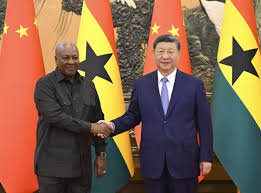
Accra, Ghana – October 15, 2025: President John Dramani Mahama’s visit to Beijing this week has deepened Ghana’s economic alignment with China, as the two nations prepare to finalize a zero-tariff trade agreement by month’s end—a move that promises expanded market access while raising persistent questions about debt sustainability, environmental governance, and the balance between infrastructure development and resource sovereignty.
The bilateral meeting on October 14, held on the sidelines of the Global Leaders’ Meeting on Women co-hosted by China and UN Women in Beijing, marked 65 years of diplomatic relations between Ghana and China. During discussions with Chinese President Xi Jinping, Mahama committed Ghana to finalizing the zero-tariff agreement, which will eliminate import duties on Ghanaian products entering the Chinese market.
China’s Expanding Economic Footprint
China’s investment presence in Ghana is substantial. Over the past decade, Chinese foreign direct investment has reached $3.9 billion, funding 424 projects and creating more than 39,000 jobs, according to data from Ghana Investment Promotion Centre CEO Simon Madjie presented at the Ghana-China Business Summit in June 2025. Of this total, approximately $2.7 billion flowed into the manufacturing sector, with the remainder distributed across trading, construction, and services.
Bilateral trade between Ghana and China reached $11.8 billion in 2024, representing a 7.1 percent year-on-year increase, according to Chinese Ambassador to Ghana Tong Defa. China remains Ghana’s largest trading partner and a major source of foreign investment, with hundreds of Chinese enterprises operating across infrastructure, manufacturing, mining, aviation, green energy, and petroleum refining sectors.
However, trade figures reveal a significant imbalance. Between 2020 and 2024, China’s exports to Ghana rose by nearly 46 percent while Ghana’s exports to China increased by just over 11 percent. This disparity reflects Ghana’s continued reliance on exporting raw materials—primarily gold, cocoa, and timber—while importing manufactured goods, machinery, electronics, and textiles from China.
The controversial $2 billion Sinohydro Master Project Support Agreement, signed in 2018, exchanges Ghana’s refined bauxite for infrastructure development over a 15-year period. Under this arrangement, Sinohydro funds infrastructure projects including roads, bridges, and interchanges, with repayment made through proceeds from refined bauxite sales placed in an offshore escrow account. The agreement includes a guaranteed 30 percent local content provision, higher than earlier China-Africa arrangements.
Environmental and Social Costs
Environmental concerns surrounding Chinese mining operations in Ghana have intensified. Illegal small-scale gold mining, known locally as galamsey, has involved significant Chinese participation, resulting in devastated water bodies, destroyed forests, and mercury pollution in rivers. In October 2025, Ghana’s National Anti-Illegal Mining Operations Secretariat arrested two Chinese nationals believed to be financiers of illegal mining operations in the Tano Anwia Forest Reserve during coordinated crackdowns.
A recent Atlantic Council report published October 5, 2025, documented how Chinese companies exploit policy gaps and weak regulatory enforcement across mineral-rich West African countries. The report noted that Chinese actors deploy heavy machinery in small-scale mining operations, causing land degradation, ecosystem destruction, deforestation, and biodiversity loss. The blurred lines between formal and illegal mining operations make comprehensive monitoring nearly impossible, enabling continued environmental harm with minimal accountability.
Bauxite mining in the ecologically sensitive Atewa Forest Reserve has sparked particular controversy. The forest, internationally recognized as a Globally Significant Biodiversity Area and classified as a protected forest reserve spanning 26,000 hectares, provides water for approximately 5 million Ghanaians. Bauxite extraction through strip mining requires removing layers of soil and rock, necessitating complete clearing of trees and vegetation. Environmental organizations and international manufacturing companies including BMW Group, Tetra Pak, and Schüco International have signaled concern over using bauxite sourced from Atewa Forest, citing unacceptable environmental and social risks.
The Zero-Tariff Initiative and Multipolar Competition
Ghana’s zero-tariff agreement forms part of China’s broader policy announced in June 2025 to extend zero-tariff treatment covering 100 percent of tariff lines to all 53 African countries maintaining diplomatic relations with China. This policy, which expanded on an earlier measure that took effect December 1, 2024, granting zero-tariff treatment to 33 African least developed countries, represents a significant trade opening. China became the first major economy to implement such comprehensive duty-free access for African products.
During the October 14 meeting, President Xi called on both sides to jointly implement outcomes from the 2024 Beijing Summit of the Forum on China-Africa Cooperation, held in September 2024. The summit produced ten partnership actions for modernization covering mutual learning between civilizations, trade prosperity, industrial chain cooperation, connectivity, development cooperation, healthcare, rural revitalization, people-to-people exchanges, green development, and common security. China committed to providing 360 billion yuan of financial support over three years to implement these actions.
President Mahama also expressed Ghana’s support for China’s Global Governance Initiative, unveiled by President Xi on September 1, 2025, at the Shanghai Cooperation Organization Plus Meeting in Tianjin. The initiative, China’s fourth global initiative following the Global Development Initiative, Global Security Initiative, and Global Civilization Initiative, advocates for five principles: adherence to sovereign equality, abiding by international rule of law, practicing true multilateralism, advocating a people-centered approach, and focusing on real actions.
Sovereignty and Development Trade-offs
The 65-year diplomatic relationship between China and Ghana, established on July 5, 1960, has evolved from Kwame Nkrumah’s Pan-African solidarity with Zhou Enlai’s anti-colonial vision into a complex economic partnership. Ghana was among the first sub-Saharan countries to establish diplomatic relations with China and the first sub-Saharan country that Chinese leaders visited. In 2024, the two countries elevated bilateral relations to a strategic partnership.
While Ghana has consciously structured agreements like the Sinohydro deal to avoid being classified as adding to the government’s debt stock—learning from debt sustainability challenges faced by other African nations—fundamental questions persist about whether these arrangements advance genuine economic transformation. The Ghana Integrated Aluminium Development Corporation serves as the obligor under the Sinohydro agreement, with the structure designed to ensure obligations do not add to Ghana’s debt stock, though if GIADC fails to comply with collateral or repayment obligations, Sinohydro can demand prepayment and seize the escrow account balance.
Ghana possesses bauxite reserves that could underpin an integrated aluminum industry from mining through refining to manufacturing, yet refineries remain unbuilt and infrastructure incomplete. The COVID-19 pandemic delayed construction timelines, leaving Ghana vulnerable to exporting raw bauxite rather than processed aluminum with higher value-added potential.
Vice President Naana Jane Opoku-Agyemang, speaking at celebrations marking the 76th anniversary of the founding of the People’s Republic of China and the 65th anniversary of China-Ghana diplomatic relations in September 2025, emphasized Ghana’s determination to ensure trade relations “translate into sustainable local development, with emphasis on creating opportunities for our brilliant and determined youth”. She called for deeper collaboration in renewable energy, digital technology, and trade facilitation under the African Continental Free Trade Area framework.
As President Mahama concluded his Beijing visit, he emphasized the importance of sustaining collaboration through strategic investments in technology, infrastructure, and value-added industries. The question facing Ghana is whether Chinese engagement can successfully convert into domestic productive capacity that processes raw materials into finished goods—or whether agreements primarily facilitate continued extraction of resources in exchange for infrastructure built by Chinese contractors employing predominantly Chinese workers.
The zero-tariff policy offers Ghana unprecedented duty-free access to the world’s second-largest economy. However, as analysts noted, tariffs are not the primary barrier preventing Ghana from exporting more to China—the binding constraint is productive capacity and the ability to manufacture at scale goods that meet Chinese market standards and consumer preferences. Without addressing these structural challenges through investments in manufacturing infrastructure, skills development, and quality certification, the zero-tariff agreement risks widening rather than narrowing Ghana’s trade deficit with China.
