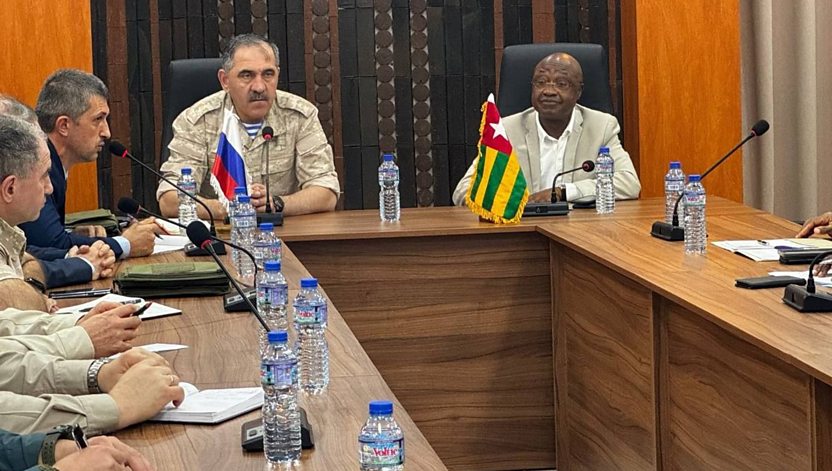
Lomé, Togo – October 8, 2025: Russia’s State Duma ratified a military cooperation agreement with Togo on October 6, marking Moscow’s strategic advancement into West Africa’s Gulf of Guinea region. The framework agreement was signed in Lomé on March 27 and confirmed in Moscow on April 3, establishing the legal foundation for joint military exercises, training programs, and military equipment exchanges between the two nations.
The ratification represents Russia’s calculated expansion beyond the landlocked Sahel nations of Mali, Niger, and Burkina Faso, where its Africa Corps paramilitary forces have replaced French influence. Togo’s Port of Lomé, which handled 30.6 million tons of cargo in 2024, represents a critical Atlantic gateway and potential naval projection point.
Russia’s Gulf of Guinea Maritime Strategy
The Togo agreement signals Russia’s shift from purely landlocked operations to maritime access. Vladimir Gruzdev, a member of Russia’s Government Commission on Legislative Activity, described Togo as “one of the most organised and equipped countries in Tropical Africa,” highlighting its control of “the busiest seaport in West Africa”. Russian Ambassador Igor Evdokimov revealed Moscow’s naval interests, stating that simplified procedures for Russian warship visits to Togolese ports would “strengthen Russia’s strategic presence in the region”.
The military cooperation framework encompasses joint exercises, training programs for Togolese personnel, weapons and equipment exchanges, and provisions for “hydrography, navigation and combatting piracy”. These naval-focused elements distinguish the Togo agreement from Russia’s land-based partnerships with interior Sahel nations, suggesting Moscow views Lomé as a strategic maritime hub.
Togo’s Security Imperatives Drive Russian Engagement
President Faure Gnassingbé’s government faces escalating jihadist threats that have transformed Togo from a peaceful coastal state into a frontline battleground. JNIM (Jama’at Nusrat al-Islam wal-Muslimin), al-Qaeda’s Sahel affiliate, launched a major cross-border attack in July 2024, overrunning the Kpankankandi military base and killing at least 12 Togolese soldiers while seizing weapons and vehicles.
According to Togolese Foreign Minister Robert Dussey, jihadist attacks have killed at least 62 people in northern Togo since January 2025, more than double the 2023 death toll. These security pressures coincide with Togo’s controversial constitutional changes that have effectively granted Gnassingbé indefinite rule through a new “President of the Council of Ministers” position.
Togo’s military modernization through Russian weapons accelerated since 2022, when Moscow delivered three Mi-35M combat helicopters and two Mi-17 transport helicopters in November. Despite equipment challenges, including one Mi-35 crash during counterinsurgency operations in April 2024, Russian military cooperation has continued.
Western Powers Respond to Russian Expansion
The United States has intensified engagement with Togo as Russia’s military footprint expands. In July 2025, U.S. Chargé d’Affaires Richard C. Michaels conducted high-profile visits to the Port of Lomé, promoting American investment in logistics and infrastructure. The U.S. Embassy characterized Lomé as offering “unmatched access to African markets” with “advanced deep-water capabilities” and “annual throughput exceeding 30 million tonnes”.
France’s diminished position following its complete military withdrawal from West Africa has limited Paris’s ability to counter Russian expansion effectively. France officially completed its military withdrawal from Senegal on July 17, 2025, ending its last permanent military presence in West Africa after 65 years. The withdrawal of approximately 350 French troops marked the conclusion of France’s military footprint in the region.
Regional implications extend to fundamental questions about ECOWAS unity and effectiveness. Nigerian analysts have expressed concern about Russian military forces operating along Nigeria’s borders, noting potential complications for cross-border security cooperation.
Africa Corps Expansion Strategy
Russia’s paramilitary operations in Africa have transitioned from the Wagner Group to the Africa Corps, a new formation fully subordinate to the Russian Ministry of Defense. Following Wagner leader Yevgeny Prigozhin’s death in 2023, Moscow restructured its African operations under direct state control, with an estimated 70-80% of Africa Corps personnel being ex-Wagner members.
The Africa Corps maintains presence in at least six African countries that were previously Wagner theaters, including Mali, Central African Republic, Libya, Sudan, Niger, and Burkina Faso. Deputy Defense Minister Yunus-Bek Yevkurov has been coordinating expanded deployments across the Sahel region while pursuing new military cooperation agreements on Africa’s Atlantic coast.
The ratification of Russia’s military cooperation agreement with Togo represents another milestone in Moscow’s systematic expansion across Africa, extending from landlocked Sahel operations to strategic maritime access points. The partnership reflects broader regional dynamics where traditional Western partners have been displaced by more assertive competitors offering immediate security solutions to embattled governments facing existential threats.
As Russian Foreign Minister Sergey Lavrov stated during recent African visits, Moscow seeks to fill security vacuums created by Western military withdrawals while positioning Russia as a reliable partner for African sovereignty. For Togo, balancing relationships with competing global powers while addressing immediate security threats requires careful diplomatic navigation in an increasingly multipolar world.
