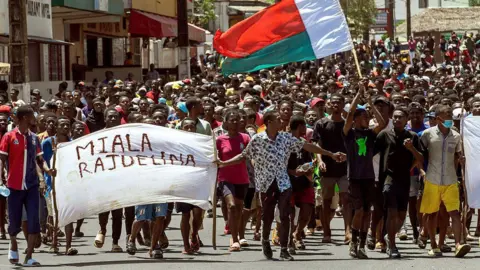
Antananarivo, Madagascar – October 8, 2025: Madagascar’s healthcare sector has joined the nation’s Gen Z-led protest movement as hundreds of medical students and junior doctors abandoned their posts at Joseph Ravoahangy Andrianavalona Hospital on Tuesday to march on the Ministry of Health. This latest development adds critical public service workers to a youth uprising that has paralyzed the Indian Ocean island since September 25, killing at least 22 people and forcing dramatic government changes.
The medical workers’ strike represents a significant escalation of the Gen Z Mada movement, which initially erupted over chronic water and electricity shortages but has evolved into broader demands for President Andry Rajoelina’s resignation. Their protest was met with tear gas and violent suppression by security forces after police blocked their march just meters from the Ministry of Health.
“We are doing this for the Malagasy people because the quality of care in Madagascar is very poor,” declared one striking protester. “We will not return to work until our demands are met”. Medical students earning approximately €0.25 per hour and junior doctors paid barely €100 monthly are demanding salary increases to €240 while announcing the suspension of minimum services in public hospitals.
Healthcare Crisis Exposes Systemic Failures
The medical workers’ grievances reflect the broader infrastructure collapse that sparked Madagascar’s largest youth uprising in years. Dr. Santatra Andriamanantsoa revealed the devastating conditions: “In terms of equipment and infrastructure, the situation is already so precarious—that’s the only word that can describe it. In terms of workload, doctors see around 50 to even 100 patients in some hospitals”.
The healthcare system’s breakdown mirrors the electricity and water crisis that initially triggered the Gen Z protests on September 25. Antananarivo residents face up to 12 hours of daily power outages and severe water shortages caused by mismanagement of the state utility JIRAMA. One protester told media: “In my house for instance we haven’t had running water for six years, and yet we’re still paying the bills”.
These service failures occur while President Rajoelina’s government invests in high-profile projects like a $152 million cable car system spanning 13 kilometers in Antananarivo, widely criticized as irrelevant to citizens’ basic needs. The contrast between elite spending and public suffering has fueled youth anger, with protesters adopting the skull and crossbones symbol from the Japanese anime “One Piece”—representing pirates fighting repressive government—a symbol also used in recent Gen Z protests across Asia.
Military Appointment Fails to Quell Movement
President Rajoelina’s appointment of military General Ruphin Fortunat Zafisambo as Prime Minister on Monday has failed to satisfy protesters, who rejected the military solution and issued a 48-hour ultimatum for the president’s resignation. The Gen Z Mada movement, coordinated through social media platforms including Facebook and TikTok, has expanded beyond Antananarivo to eight other cities across Madagascar.
The protests have claimed at least 22 lives according to UN Human Rights Chief Volker Türk, with over 100 injured during violent confrontations with security forces. The Malagasy government has disputed these figures, but multiple sources confirm significant casualties from both security force responses and widespread looting that accompanied the demonstrations.
Opposition leaders have expressed support for the protesters, with former President Marc Ravalomanana and opposition figure Siteny Randrianasolona declining to join any government under Rajoelina, calling such cooperation “a betrayal of the Malagasy people”. Civil society organizations have demanded church-led dialogue to prevent Madagascar from descending into “chaos or civil war”.
The timing of the medical workers’ strike, occurring just one day after Rajoelina’s military appointment, demonstrates the protesters’ determination to reject cosmetic political changes while demanding fundamental governance reforms. As demonstrations enter their third week, the youth-led movement shows no signs of abating despite violent crackdowns and attempted government concessions.
The junior doctors’ decision to join the Gen Z uprising reflects a broader pattern of professional sectors aligning with youth demands for systemic change in Madagascar, where 75% of the 30 million population lives below the poverty line while political elites maintain visible wealth. Their participation transforms what began as protests over utility failures into a comprehensive challenge to governance structures that have failed to deliver basic services to citizens.
