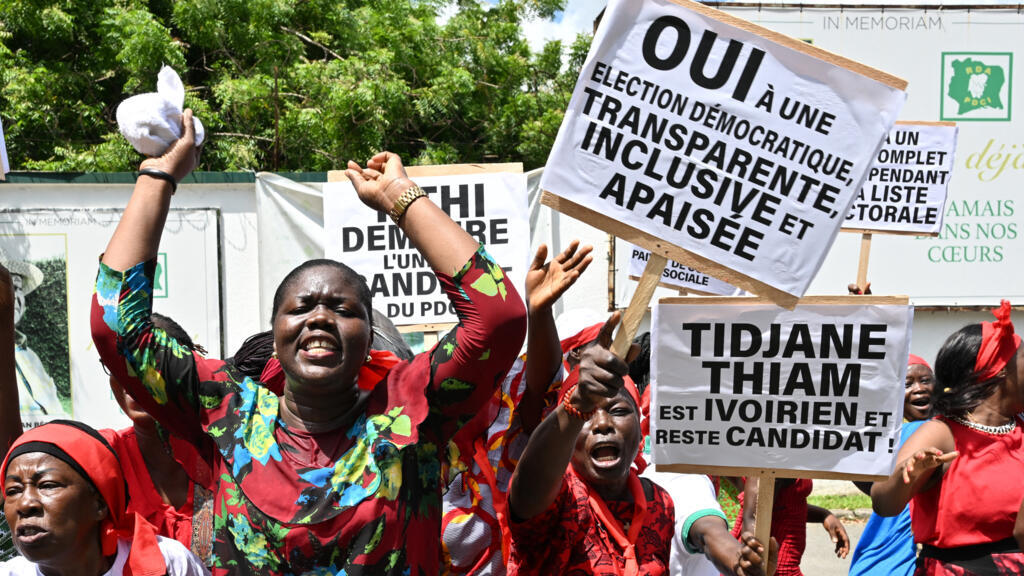
Abidjan, Côte d’Ivoire – October 12, 2025: The planned opposition demonstration in Abidjan on October 11 descended into state violence as security forces deployed tear gas and arrested 237 protesters, marking a significant escalation in tensions ahead of President Alassane Ouattara’s bid for a fourth term in the October 25 presidential election.
What began as a legally announced march organized by the United Front coalition—comprising former President Laurent Gbagbo’s African People’s Party (PPA-CI) and former Credit Suisse CEO Tidjane Thiam’s Democratic Party of Côte d’Ivoire (PDCI-RDA)—was systematically suppressed by security forces. The crackdown occurred precisely where organizers had announced the demonstration would begin: near the Saint Jean church roundabout in Cocody district.
By 11:30 a.m., Interior and Security Minister General Vagondo Diomandé confirmed the mass arrests during a press conference, stating “As of 11:30 a.m. (local time), 237 people have been arrested, among them women and young people”. The minister criticized what he called “some completely irresponsible young people were sent into the streets to erect barricades”.
The demonstration had been formally banned by the Abidjan prefect on Friday, October 10, citing “the need to maintain public order” during the electoral period. Despite the opposition’s previous claims that procedural notifications had been properly submitted, authorities maintained the protest violated Article 138 of the Constitution, which regulates public gatherings.
The timing of this suppression was particularly significant. As protesters faced tear gas in Abidjan, Ouattara was simultaneously launching his campaign for a fourth term at a rally in Daloa, approximately 380 kilometers west of Abidjan. Speaking to thousands of supporters, Ouattara promised new infrastructure projects, including a road linking Daloa to the capital Yamoussoukro.
Regional Bodies Maintain Diplomatic Silence
The crackdown occurred despite the presence of international observers in the country. The Economic Community of West African States (ECOWAS) had deployed a Long-Term Election Observation Mission (LTEOM) to Côte d’Ivoire on October 3, led by Ambassador Fanta Cissé. The mission, established under the ECOWAS Additional Protocol on Democracy and Good Governance, aims to monitor electoral processes and ensure “credible, transparent, and peaceful presidential elections”.
However, ECOWAS has not issued any public statement condemning the violent suppression of the October 11 protest. The organization’s pre-election mission, led by Professor Théodore Holo since June 30, had been meeting with various stakeholders including the Independent Electoral Commission and civil society groups.
The arrests came just days after the Media Foundation for West Africa (MFWA), in partnership with ECOWAS, concluded training sessions for Ivorian journalists and civil society organizations on countering misinformation ahead of the election. The training, held from September 29 to October 3, emphasized the need for “innovative strategies” to support peaceful electoral processes.
Journalists covering the October 11 protest faced harassment, with reports of professional equipment being seized and images deleted by police. Some protesters vowed that “there will be other protests” despite the heavy-handed response.
Constitutional Exclusions and Diminished Competition
The violent suppression of protests must be understood within the context of systematic exclusion of opposition candidates from the electoral process. In September 2025, Côte d’Ivoire’s Constitutional Council, led by President Chantal Nanaba Camara, validated only five candidates out of 60 applications, including Ouattara’s.
Laurent Gbagbo was barred due to his criminal conviction at the International Criminal Court, while Tidjane Thiam was excluded after a court ruled in April that he had forfeited his Ivorian citizenship when he acquired French nationality in 1987. Habiba Touré, spokesperson for Gbagbo’s PPA-CI party and a Franco-Ivorian lawyer who has served as Gbagbo’s chief of staff, had been actively campaigning for the reinstatement of both leaders on the electoral list.
The exclusions have left Ouattara facing minimal credible opposition. Among the approved candidates is Simone Gbagbo, Laurent Gbagbo’s ex-wife, though analysts consider her unlikely to pose a serious challenge to the incumbent.
France’s Strategic Repositioning
The October 11 events occurred against the backdrop of France’s military withdrawal from Côte d’Ivoire, announced by Ouattara in December 2024. The handover of France’s Port-Bouet military base was completed in February 2025, ending more than 50 years of French military presence and transferring control of the 43rd Marine Infantry Battalion to Ivorian forces.
The base has been renamed Camp Thomas d’Aquin Ouattara in honor of the nation’s first army chief. Despite the withdrawal of approximately 600 French troops, around 80 soldiers remain for training and advisory missions. President Ouattara emphasized that France would continue as “a valued partner in training, intelligence and especially in the fight against terrorism”.
This withdrawal positions Côte d’Ivoire alongside other West African nations including Mali, Burkina Faso, Niger, Senegal, and Chad that have severed or reduced military ties with France. Unlike the more contentious withdrawals in Sahel countries, Côte d’Ivoire’s transition has been characterized as cordial.
The political significance of this timing cannot be understated. Even as Ouattara distances himself from visible French military presence—likely in response to growing anti-French sentiment across the region—the violent suppression of opposition voices suggests that authoritarian governance patterns remain intact regardless of foreign military presence.
The events of October 11 represent more than isolated election violence—they constitute a systematic assault on democratic space by a leader determined to secure a fourth term despite constitutional questions about term limits. Ouattara formalized his candidacy in July 2025 amid widespread criticism that his bid violates constitutional provisions, particularly given a 2016 constitutional amendment that eliminated presidential term limits.
As Côte d’Ivoire approaches its October 25 election, the combination of opposition exclusions and violent suppression of dissent raises serious questions about the credibility of the democratic process. While international observers remain present, their silence in the face of documented state violence suggests the limitations of external oversight when strategic interests are at stake.
The warning from one protester that “there will be other protests” indicates that state repression may have only delayed rather than deterred opposition mobilization. With two weeks remaining until the election, Ouattara’s strategy of maintaining power through exclusion and intimidation will face its ultimate test—whether such methods can provide lasting stability or merely postpone a deeper reckoning with popular discontent.
