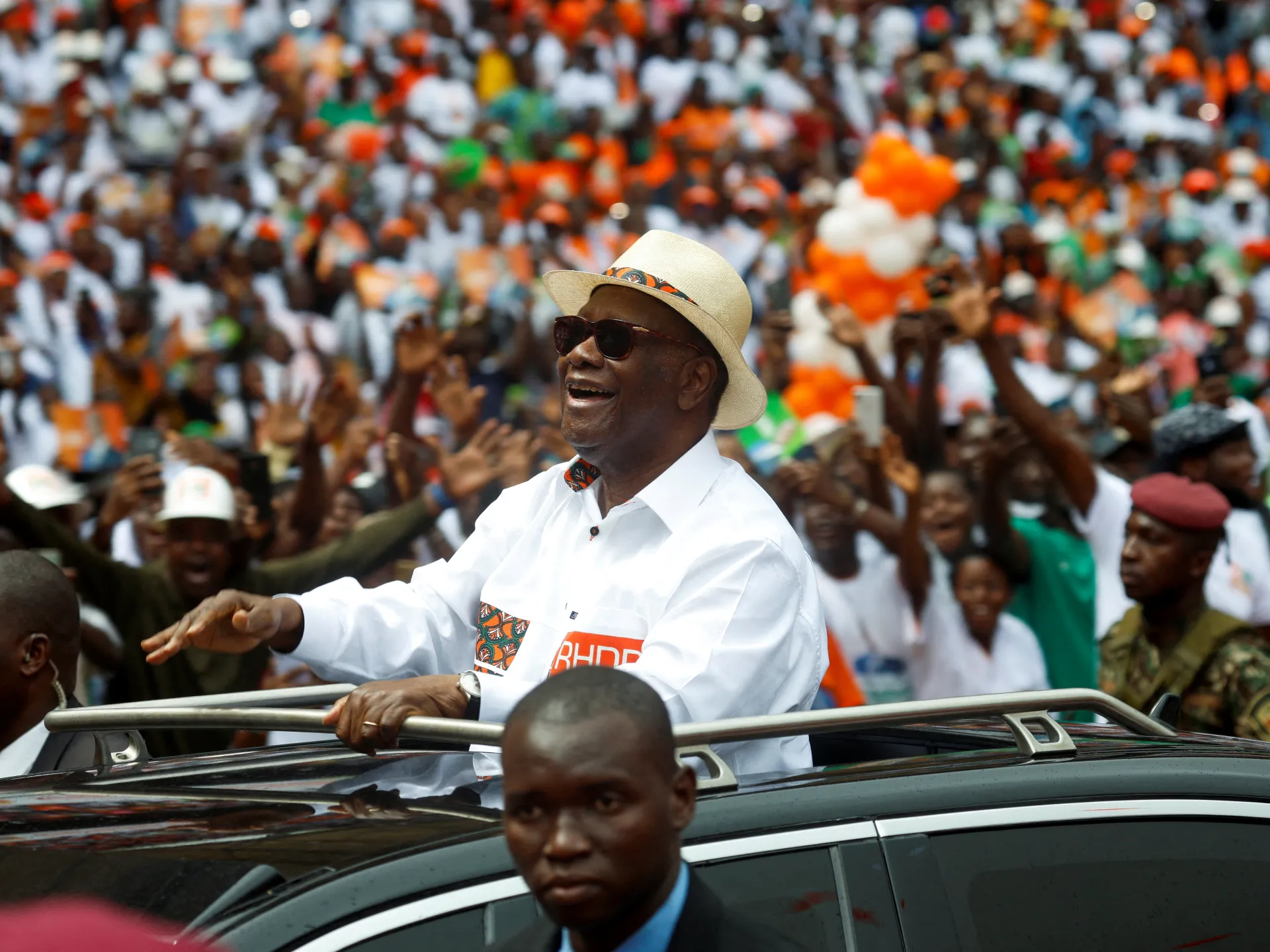
Abidjan, Ivory Coast – October 11, 2025: Ivory Coast’s presidential campaign officially began Friday with incumbent President Alassane Ouattara seeking a fourth term amid significant controversy over the exclusion of key opposition figures from the October 25 ballot. The Constitutional Council approved only five candidates out of 60 applications, barring former President Laurent Gbagbo and opposition leader Tidjane Thiam on legal grounds that their supporters contest as politically motivated.
Ouattara, born January 1, 1942, making him 83 years old, launched his campaign in Abidjan alongside four other approved candidates: Simone Gbagbo (former first lady and ex-wife of Laurent Gbagbo), Jean-Louis Billon of the Democratic Congress, independent candidate Ahoua Don Mello, and Henriette Lagou of the GP-Paix coalition. The exclusions have triggered protests, with opposition parties planning demonstrations that authorities banned in early October.
The systematic removal of major opposition figures has raised concerns about democratic competition in this West African nation of approximately 32.7 million people as of 2025. Laurent Gbagbo was excluded due to his 2018 criminal conviction for allegedly looting the central bank during the 2010-2011 post-electoral crisis, despite receiving a presidential pardon in 2020 that did not restore his political rights. Tidjane Thiam, the former Credit Suisse CEO who leads the main opposition PDCI party, was removed after a court ruled he lost Ivorian nationality when he acquired French citizenship in 1987, despite renouncing his French passport in March 2025.
Economic Stakes and Historical Context
Ivory Coast remains the world’s largest cocoa producer, accounting for approximately 45% of global cocoa supply as of 2024. The country produces over 2.3 million tonnes annually, making political stability crucial for the global chocolate industry. The nation has transformed from a decade of civil conflict in the early 2000s into one of West Africa’s fastest-growing economies.
The specter of past electoral violence looms large over the current campaign. The 2010-2011 post-electoral crisis resulted in at least 1,012 confirmed deaths according to UN investigators, with 505 deaths occurring in the western city of Duékoué alone during intercommunal violence. The crisis began when Laurent Gbagbo refused to accept his electoral defeat to Ouattara following the UN-certified November 2010 election results.
France’s role in Ivory Coast has evolved significantly, with the former colonial power completing its military withdrawal in February 2025 after decades of deployment. The handover of France’s Port-Bouët military base marked the end of direct French military involvement, though approximately 80 French advisors remain for training purposes. This withdrawal reflects broader changes across West Africa, where former French colonies have increasingly distanced themselves from their former colonial power.
Regional Context and Democratic Legitimacy
The exclusion of major opposition figures has raised questions about the election’s legitimacy and competitiveness. With Laurent Gbagbo and Tidjane Thiam barred from the race, Ouattara faces only minor opposition candidates lacking significant political machinery or popular support. Political analysts suggest this configuration makes Ouattara’s victory highly likely but potentially undermines the democratic credibility of the process.
ECOWAS has deployed election observers to monitor the process, though the regional body has remained largely silent on the candidate exclusions. This contrasts with ECOWAS’s swift responses to military coups in Mali, Niger, and Burkina Faso, highlighting different approaches to democratic backsliding depending on the method employed.
The opposition has condemned what they describe as an “organized plebiscite” designed to ensure Ouattara’s victory. Tidjane Thiam called the candidate selection process “a decisive test” for democracy, urging an end to “attacks on democracy and the denial of the law”. Despite stepping down as PDCI party leader due to his exclusion, Thiam maintains he will continue fighting for electoral victory.
Information warfare has emerged as a concern, with reports of Russian disinformation campaigns targeting West African elections, though specific evidence of interference in Ivory Coast’s 2025 election remains limited. Social media manipulation included false coup rumors that circulated in May 2025, demonstrating the vulnerability of the region’s information environment.
As campaigning intensifies ahead of the October 25 vote, the stakes extend beyond Ivory Coast’s borders. The election will test whether regional institutions and the international community will accept constitutional manipulation when executed by established leaders in economically strategic nations. For a continent grappling with democratic regression and military coups, the outcome may signal whether electoral engineering represents an acceptable alternative to honest democratic competition.
The streets of Abidjan reflect these tensions, with security forces maintaining a heavy presence as opposition supporters voice their frustrations through banned demonstrations. Whether these voices will influence an outcome that appears increasingly predetermined remains the central question as Ivory Coast heads toward what may prove to be its most contentious election since 2010.
