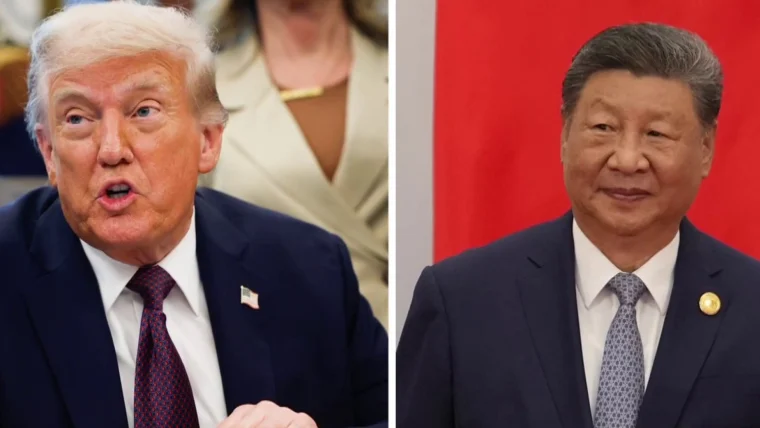
Abuja, Nigeria – October 11, 2025: The escalating trade war between Washington and Beijing has reached new heights, with China’s latest rare earth export controls prompting President Donald Trump to announce additional 100% tariffs on Chinese imports, effective November 1. This dramatic escalation reflects deeper tensions over critical mineral access and highlights opportunities for Africa to leverage its substantial mineral reserves in an increasingly contested global supply chain.
On October 8, 2025, China’s Ministry of Commerce announced sweeping new export restrictions on rare earth elements through Notice 2025 No. 61, expanding controls to include five additional elements: holmium, erbium, thulium, europium, and ytterbium. These restrictions, which take effect December 1, 2025, require foreign companies to obtain export licenses for products containing even 0.1% Chinese-origin rare earth materials.
The new regulations represent China’s most comprehensive rare earth restrictions to date, targeting not only raw materials but also processing technologies and equipment. Foreign entities must now secure dual-use export permits from Beijing before exporting products made with Chinese rare earth materials or technologies, even when manufactured outside China.
China maintains approximately 69-70% of global rare earth mining production and controls roughly 90% of global processing capacity. According to the US Geological Survey, China holds about 44 million metric tons of rare earth reserves, representing approximately 48% of global reserves, with production quotas of 270,000 metric tons in 2024.
The timing of these restrictions is significant, coming weeks before the scheduled Asia-Pacific Economic Cooperation (APEC) summit in Gyeongju, South Korea, from October 31-November 1, 2025, where Trump and Xi Jinping were expected to meet.
Trump’s 100% Tariff Response Creates Market Upheaval
President Trump’s announcement of additional 100% tariffs on Chinese goods, on top of existing tariffs currently averaging approximately 30%, represents the most significant escalation in US-China trade tensions in months. The new tariffs, which Trump threatened could take effect “sooner” depending on Chinese actions, would bring total US tariffs on Chinese goods to approximately 130%.
“It was shocking,” Trump stated about China’s rare earth restrictions, calling Beijing’s actions “extraordinarily aggressive” and accusing China of holding the world “captive”. The president initially suggested he would not meet with Xi Jinping at the APEC summit, stating on Truth Social: “I was to meet President Xi in two weeks, at APEC, in South Korea, but now there seems to be no reason to do so”.
However, Trump later clarified he had not formally cancelled the meeting, telling reporters: “I haven’t canceled, but I don’t know that we’re going to have it. But I’m going to be there regardless. So I would assume we might have it”.
The announcement sent shockwaves through financial markets, with the S&P 500 falling 2.7% in its steepest decline since April, while the Nasdaq dropped 3.6%. Conversely, US rare earth mining stocks surged, with USA Rare Earth gaining 12.7% and MP Materials jumping 13.5%.
Africa’s Strategic Mineral Position Gains Prominence
Africa holds approximately 30% of global critical mineral reserves essential for green technology, including substantial deposits of cobalt, lithium, graphite, and other strategic materials. The continent possesses 53% of global cobalt reserves, 25% of bauxite, 21% of graphite, 46% of manganese, and 91% of platinum group metals.
The Democratic Republic of Congo, which accounts for approximately 70% of global cobalt production, has implemented its own resource control measures through export quotas. In October 2025, the DRC transitioned from an export ban imposed in February to a quota system allowing 18,125 metric tons of cobalt exports for the remainder of 2025, with annual caps of 96,600 tons for 2026 and 2027.
President Felix Tshisekedi has warned that cobalt exporters violating the new quota system will face permanent bans, asserting the country “will not be controlled by Chinese” firms. The DRC’s cobalt export restrictions contributed to a 92% price rebound since March 2025.
The African Union formally adopted the African Green Minerals Strategy (AGMS) in February 2025, providing a continental framework to harness Africa’s mineral wealth for sustainable development and industrialization. The strategy aims to move Africa beyond raw mineral exports toward integrated value chains that foster local beneficiation and economic diversification.
The current crisis offers African nations opportunities to demand more favorable terms from both the US and China as they seek to diversify supply chains away from Chinese dominance. Eight major African rare earth projects are expected to supply significant portions of global demand by 2029 if coupled with domestic processing capabilities.
As global demand for critical minerals is projected to increase at least six-fold by 2030, driven by renewable energy transitions and digital technologies, Africa’s position becomes increasingly strategic. The unfolding US-China tensions highlight the importance of mineral sovereignty and the risks of supply chain concentration, potentially providing African nations with enhanced leverage in negotiating terms that prioritize domestic value addition over extractive relationships.
The coming months will test whether African leaders can transform their mineral advantages into genuine economic power or remain caught between competing imperial interests seeking control over their resources.
