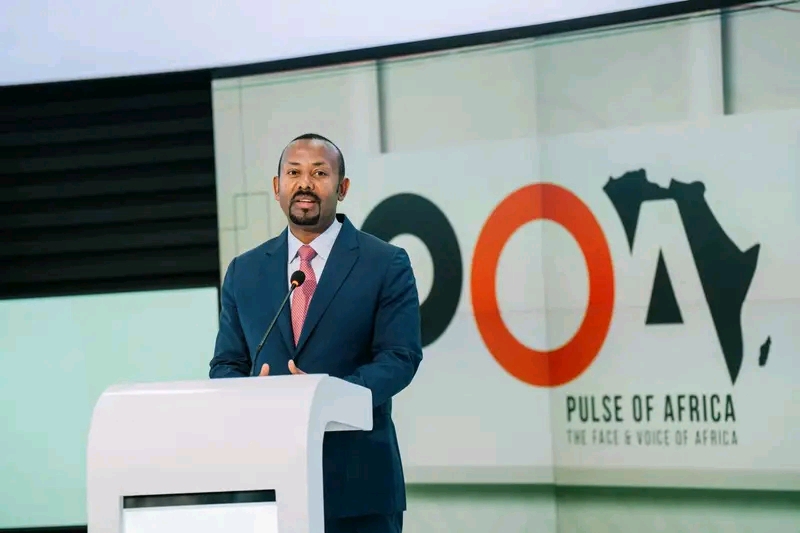
ADDIS ABABA, Ethiopia – October 9, 2025: Prime Minister Abiy Ahmed’s launch of Pulse of Africa (POA) on October 7 represents more than a media platform—it signals Ethiopia’s bid to control continental narratives at a time when foreign powers increasingly weaponize African media landscapes. Yet beneath the Pan-African rhetoric lie troubling questions about funding transparency, government control, and whether this represents genuine media sovereignty or sophisticated state propaganda masquerading as African liberation.
The timing of POA’s launch coincides with Ethiopia’s deepening authoritarian drift, where multiple journalists have been detained since 2019, making it the second-leading jailer of journalists in sub-Saharan Africa after Eritrea. Ethiopia dropped to 145th out of 180 countries in the 2025 World Press Freedom Index, placing it in the “very serious” category alongside Yemen and Sudan. This context transforms Abiy’s calls for “authentic African storytelling” into a potentially Orwellian exercise where the same government silencing domestic voices now claims to champion continental media freedom.
Research reveals that Ethiopian state media heavily relies on Chinese state sources, particularly Xinhua News Agency, for coverage of Chinese-Ethiopian relations. This dependency creates an uncomfortable parallel to POA’s mission, raising questions about whether Ethiopia’s version of “African narratives” simply replaces Western editorial influence with Ethiopian government control, backed by Beijing’s media strategy.
The Geopolitical Chess Game Behind African Media
POA’s emergence reflects broader geopolitical competition for influence over African information ecosystems. China has invested heavily in African media infrastructure and training programs, though claims of a specific “$6-billion Voice of China enterprise” could not be independently verified in available sources. China’s media strategy in Africa includes content distribution partnerships, direct investments, equipment donations, and training programs for over 3,000 African broadcasting professionals by 2022.
Ethiopia’s strategic position as Africa’s diplomatic capital provides POA significant symbolic power. However, civil society voices remain conspicuously absent from public discourse about the platform. Opposition groups, including the Amhara Fano resistance movement and various ethnic liberation movements, have been systematically silenced by Abiy’s government. Their absence from conversations about POA’s launch suggests the platform may amplify only state-approved African voices while marginalizing dissent.
Ethiopia’s Media Context and Chinese Partnerships
Ethiopia’s relationship with Beijing extends beyond infrastructure investment. Chinese contractors have discovered that Ethiopian media coverage of Chinese projects remains “overwhelmingly positive” due to government pressure, with journalists admitting that “negative news about Chinese projects is like a slap in the face to the Ethiopian government.” This dynamic suggests POA may replicate authoritarian media models rather than offer genuine African alternatives.
The platform’s Arabic and English broadcasting languages notably exclude Ethiopia’s major ethnic languages—Amharic, Oromo, and Tigrinya—potentially limiting its domestic reach while prioritizing international audiences. This choice aligns with Chinese media strategy in Africa, which focuses on shaping global perceptions rather than fostering authentic local dialogue.
US State Department reports document how Ethiopia’s government restricts press freedom, while the Ethiopian Media Authority routinely revokes licenses and imposes punitive measures on outlets deemed “unbalanced”. POA’s emergence within this authoritarian context transforms its Pan-African messaging into a sophisticated soft-power operation designed to legitimize Ethiopia’s domestic media crackdown on the continental stage.
The Ethiopian diaspora, particularly opposition voices, have remained notably silent on social media platforms about POA’s launch—a silence that likely reflects fear of government retaliation rather than support. Twitter previously suspended trends in Ethiopia due to ethnic violence incitement, highlighting how digital platforms struggle with Ethiopian information warfare.
African Union funding challenges add another layer of complexity to POA’s positioning. Sudanese billionaire Mo Ibrahim recently criticized that “70% of the $650 million annual budget of the African Union is funded by foreigners,” calling the situation “a farce.” This dependency undermines the AU’s credibility as an independent voice, raising questions about whether POA faces similar external funding pressures despite its classification as an Ethiopian government agency.
As France faces expulsion from former colonies and the US retreats from the Sahel, Ethiopia positions itself as a Pan-African media leader while simultaneously crushing domestic press freedom. This paradox reveals POA as potentially the latest iteration of media control—African in name but authoritarian in practice.
The platform’s success will ultimately depend not on government pronouncements but on whether it provides space for authentic African voices, including those currently silenced by Abiy’s regime. Without transparency in funding, editorial independence, or inclusion of opposition perspectives, POA risks becoming another tool of information control rather than the liberation it claims to represent.
“The moment has arrived to transcend borrowed perspectives and articulate our own voices,” reads POA’s editorial mission statement. Yet until Ethiopia’s government demonstrates genuine commitment to press freedom at home, such rhetoric rings hollow—revealing POA as potentially another borrowed perspective, this time dressed in Pan-African clothing but serving authoritarian interests that mirror the very patterns it claims to challenge.
