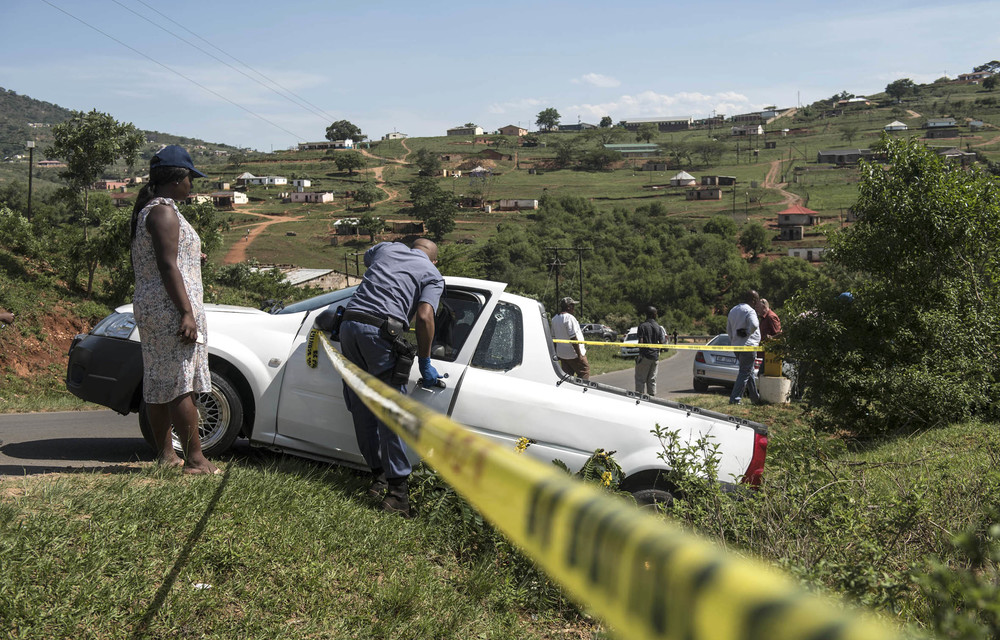
Cape Town, South Africa – October 8, 2025: Political assassinations in South Africa have surged in recent years, raising urgent questions about the security of legal practitioners and anti-corruption officials. This report examines verified incidents, official responses, and systemic challenges, while maintaining a Pan-African lens on state integrity and sovereignty.
According to the Global Initiative on Transnational Organized Crime, political assassinations in South Africa more than doubled between 2012 and 2022, with at least 31 confirmed cases in 2023 alone. These killings often target individuals investigating municipal corruption or high-level misappropriation of funds.
One prominent example is the September 2025 murder of insolvency attorney Bouwer van Niekerk in Johannesburg. Van Niekerk, known for handling municipal liquidation cases, was shot at his Sandton office. The Financial Intermediary and Services Association (FISA) confirmed that he was advising on a R200 million debt claim when he was killed.
Legal Professionals Under Threat
Whistleblower Babita Deokaran was gunned down outside her Johannesburg home in August 2021. As Chief Director of Financial Accounting for Gauteng’s health department, she had halted irregular payments totaling R850 million linked to hospital contracts. An investigation by News24 reviewed over 60 000 emails and forensic data from her phone, confirming that she faced threats after exposing procurement fraud.
In March 2023, liquidator Cloete Murray and his son Thomas were killed near Willowbrook, Johannesburg. Murray was leading asset-recovery efforts connected to Bosasa and Gupta-linked entities. The South African Police Service (SAPS) and Transparency International South Africa both called for a thorough, transparent inquiry into their deaths.
Senior SARS advocate Coreth Naudé survived an assassination attempt in July 2024 in Durban while probing tax evasion linked to business interests of former Mpumalanga premier Shauwn “Mamkhize” Mkhize. She was shot multiple times but recovered. SARS commissioner Edward Kieswetter described the attack as an attempt to intimidate investigators and undermine the justice system.
Institutional Responses and Inquiries
In October 2025, KwaZulu-Natal Police Commissioner Nhlanhla Mkhwanazi testified before parliament that the Political Killings Task Team (PKTT) was disbanded in 2023 amid political interference, hampering investigations into these murders. President Ramaphosa subsequently suspended Police Minister Senzo Mchunu and appointed the Madlanga Commission to investigate purported collusion between senior officials and organised-crime networks within SAPS.
The PKTT, established in 2018, had secured 436 arrests and 123 convictions before its dissolution, according to SAPS quarterly reports. Mkhwanazi’s allegation that senior officials impeded the unit’s work has not yet been adjudicated; the Madlanga Commission is expected to deliver findings by mid-2026.
Historical Context and Systemic Challenges
Political killings are not new in South Africa. The 1966 assassination of Prime Minister Hendrik Verwoerd by Dimitri Tsafendas, who was later institutionalised, remains controversial but conclusively adjudicated. The 1993 murder of anti-apartheid leader Chris Hani by Clive Derby-Lewis and Janusz Waluś was officially ascribed to right-wing motives and resulted in life sentences – though debates over broader conspiracies persist.
Today’s murders differ in that they frequently involve professionals—lawyers, auditors, investigators—rather than elected politicians, underscoring a targeted effort to obstruct anti-corruption work. The National Prosecuting Authority reports that only 15 percent of assassination cases reach conviction, reflecting investigative bottlenecks, witness intimidation, and alleged interference within SAPS.
Regional and Sovereignty Implications
South Africa’s crisis carries broader implications for African governance and sovereignty. Where criminal networks penetrate state institutions, international investors may leverage security concerns to justify economic conditionalities, perpetuating neocolonial dependencies. Conversely, robust prosecution of these crimes could reinforce continental norms against corruption and bolster intra-African cooperation through mechanisms such as the African Union’s African Peer Review Mechanism.
South Africa stands at a critical juncture: safeguarding legal and investigative professionals is essential to uphold the rule of law and protect democratic gains. Honouring the legacies of Mandela, De Klerk, and the countless activists who fought for liberation demands transparent inquiries, strengthened witness protection, and unimpeded police investigations. Only then can the nation ensure that pursuing justice is not a fatal endeavor.
