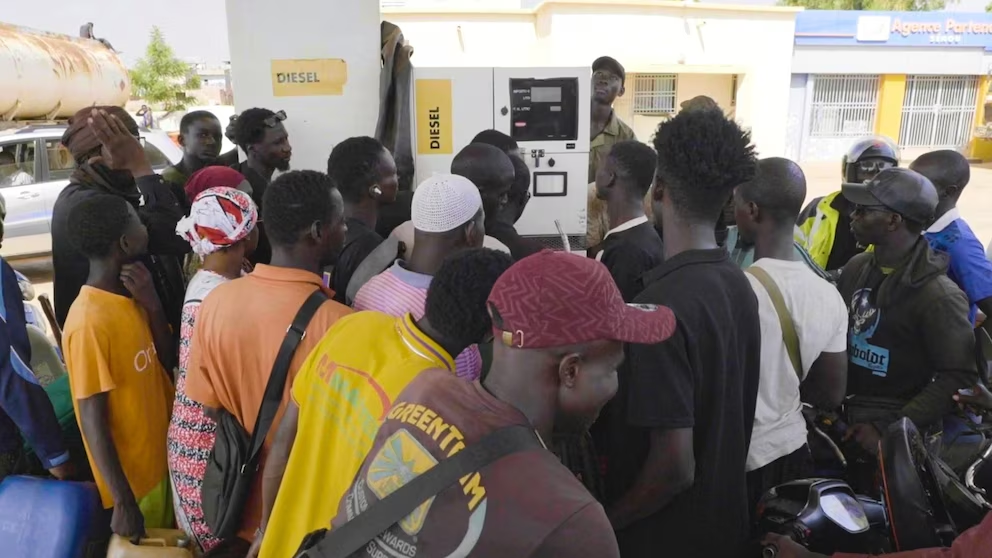
Bamako, Mali – October 08, 2025: Weeks into a deliberate blockade of fuel imports by Jama’at Nusrat al-Islam wal-Muslimin (JNIM), residents of Bamako confront dire shortages, laying bare challenges to Mali’s economic stability, regional security, and foreign influence.
Long queues of cars and motorcycle taxis have become a daily sight at Bamako’s remaining service stations, a consequence of JNIM attacks on tanker convoys from Senegal and Côte d’Ivoire since early September. Petrol reseller Bakary Coulibaly described fruitless searches across multiple stations. “It is only a few stations that have it,” he said, mirroring mounting frustration among commuters. Motorcycle taxi operator Douga Barry warned of cascading hardships: “We know we are at war, whatever the situation, and we are ready to take it on. Even if we have to stop our motorcycles to walk, we are ready for it”.
The Malian Petroleum Importers Association confirms over 100 tankers destroyed by JNIM fighters, threatening transport networks, healthcare deliveries, and food distribution. As a landlocked nation and a leading gold producer, Mali depends entirely on overland fuel imports. With nearly half of its population living below the national poverty line, the crisis risks plunging vulnerable households into deepening poverty.
Geopolitical Chessboard: Foreign Influence and Pan-African Responses
Since expelling French forces and contracting Russian private security until mid-2025, Mali’s revolutionary government has sought alternative partners, heightening competition among foreign actors for influence. While Wagner Group officially withdrew earlier this year, Moscow continues to court Bamako with diplomatic and economic overtures—contrasted by Paris’s condemnation of the revolutionary government’s alignment with Russia over ECOWAS member solidarity. Activists on social media question whether former French-backed importers are being edged out, feeding debates over neocolonial economic control and African sovereignty (“Down with outside interference,” one X user posted).
Amid the vacuum, civil society and regional bodies are experimenting with Pan-African logistics solutions. The African Centre for the Study of the Sahel proposes establishing a West African fuel corridor—linking Ghanaian refineries to Mali via Burkina Faso—to reduce dependence on coastal supply lines disrupted by jihadist blockades. Grassroots associations in Bamako have also formed community fuel cooperatives, pooling resources to charter private convoys under local tribal and municipal escorts.
At the regional level, ECOWAS’s muted response to the blockade—limited to diplomatic protests—has drawn criticism from Mali’s neighbors. In contrast, the African Union is exploring a joint security-detachment mechanism to safeguard key supply routes without deploying foreign ground troops, a move aimed at reinforcing African-led solutions over external military interventions.
The JNIM-enforced blockade reveals the fragility of Sahelian supply chains and underscores the urgency of Pan-African solidarity in logistics, security cooperation, and policy coordination. As Bamako endures empty petrol pumps, Africa’s path to genuine sovereignty will hinge on collaborative infrastructure projects and unified political will—ensuring external powers cannot exploit crises to gain strategic footholds.
